

One Simple Way to Increase Your Revenue 7%
Graham Shaw
COO
I want to start with a question that might be uncomfortable.
If someone walked into your office today and handed you a $50 check to support your mission, what would you do? You’d look them in the eye. You’d thank them. You’d make them feel like that gift mattered, because it does.
Now ask yourself: Is that the same experience your new direct response donors are getting?
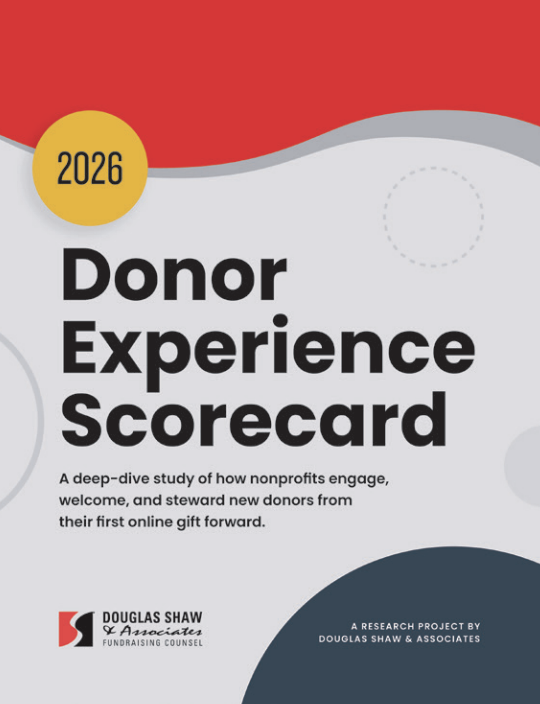
We just published the fourth annual Donor Experience Scorecard at Douglas Shaw & Associates, where we made online donations to 141 nonprofits and tracked every single touchpoint that followed. Every email, every letter, every phone call, and every silence.
One finding hits harder than the rest, and it’s the one I can’t stop thinking about. Most organizations are failing at the most fundamental act of the donor relationship—expressing genuine gratitude.
The Data Tells a Sobering Story
Out of the 141 organizations we donated to, only 35% mailed a printed receipt or acknowledgment letter. That means nearly two out of three nonprofits never put anything tangible in the donors’ hands after receiving a gift.
And for the organizations that did send a printed receipt? The average delivery time was 22 days. That’s up from 18 days the year before. Organizations aren’t getting faster at saying thank you—they’re getting slower.

Sixty-three days. A donor made a generous decision to support a cause they believed in, and two months later, they finally received an acknowledgment. By then, the emotional connection to that gift is long gone.
This Is About More than Revenue. It’s About Respect.
Yes, there’s a revenue argument here, and it’s a strong one. Across multiple clients we serve, we’ve tracked the revenue from gifts donors made in response to the thank-you they received in the mail.

Seven cents of every dollar raised comes from the response to a printed receipt. That’s not a cost center. That’s a significant revenue channel. And every organization that skips the print receipt is walking away from it.
But here’s what I really want to say: The revenue is not the point. The revenue is a byproduct of doing the right thing.
Out of every cause they could support, someone chose to be a part of your mission. That decision deserves to be honored promptly, personally, and genuinely.
We spend enormous amounts of time, energy, and money to acquire new donors, to cultivate relationships, and to gain a donor’s trust. Acquiring a first-time donor is costly. And then what?
I know the operational reality of getting a printed acknowledgment into the mail quickly is difficult. But that doesn’t change the fact that it matters deeply to the person on the other end.
Your Donors Deserve the Same Respect as the People You Serve
This is something I feel strongly about, and I think the nonprofit sector needs to hear it more often.
Organizations rightly invest tremendous care in serving the people who benefit from their programs. That care, that dignity, and that respect are the heartbeat of what makes your work meaningful.
Your donors deserve that same level of respect. They are not ATMs. They are not line items on a revenue report. They are people who have made a personal decision to invest in your cause because they believe in what you’re doing. When you fail to acknowledge that gift quickly and sincerely, you’re sending a message that their generosity wasn’t that important.
In a world where new donor retention rates hover around 20%, you simply cannot afford to treat the thank-you as an afterthought. Engaging donors quickly, personally, and with genuine appreciation isn’t just good fundraising. It’s good stewardship.
The Sector Breakdown Tells a Story
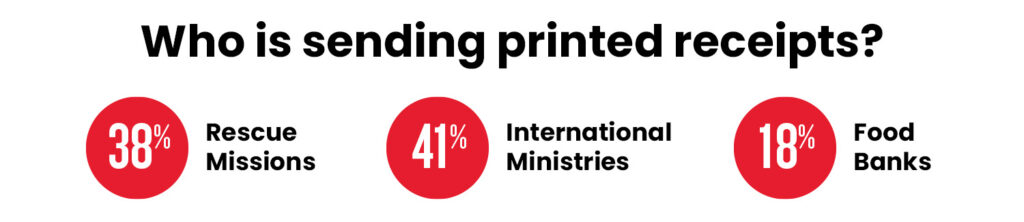
We broke the data down by sector, and the differences are revealing.
Rescue missions lead the way. 38% send a printed receipt, and they’re the fastest, with a median delivery time of 17 days. A handful of receipts delivered in just 7 days!
41% of international ministries send a printed receipt, but they take a median of 21 days to deliver.
Food banks are struggling the most. Only 18% send a printed receipt at all, and those that do take an average of 30 days.
The Multichannel Connection
Here’s the other piece that ties this together. Our proprietary data shows that donors who engage across both online and offline channels are worth 3 to 10 times more in five-year lifetime value than single-channel donors.
A printed receipt is often the first offline touchpoint for an online donor. It’s the bridge that turns a digital transaction into a multichannel relationship. When you skip it, you’re not just missing a thank-you, you’re cutting off the path to your most valuable, most loyal supporters.

A Challenge: Audit Your Own Process
If you’re a CEO, CDO, VP of Development, or anyone responsible for the donor experience at your organization, I’d challenge you to do something this week.
Audit your own receipting process, but do it the right way.
- Make a test donation to your own organization. Use a personal email and home address that isn’t flagged in your system. If your donor services team knows it’s a test, you’ll get the best-case scenario, not the real one.
- Track every touchpoint. When does the digital receipt arrive? Does it feel personal and grateful, or does it feel like a system-generated transaction? Does a printed receipt follow? How many days later?
- Check your email welcome series. Does it tell a story about the donor’s impact? Does it make the donor feel like they’re part of something meaningful?
- Look for the black holes. Are there channels you’re not using? If you’re only communicating digitally, you’re leaving multichannel value on the table. If you’re not picking up the phone, you’re missing the single most effective retention tool available. Research from Bloomerang shows that a single thank-you call boosts first-year retention by nearly 30%.
- Ask the hard question: Does your process match your intention? Most organizations believe they provide a good donor experience. The data tells us most don’t.
The Bottom Line
The organizations that are winning at donor retention aren’t doing anything revolutionary. They’re doing the basics. They’re saying thank you within days, not weeks. They’re following up with a welcome series that makes the donor feel seen and valued. They’re picking up the phone. They’re treating every first-time donor like the beginning of a relationship, not the end of a transaction.
Want to Know How Your Organization Scored?
If you want to view the full study—including data on website speed, payment options, welcome series adoption, communication strategies, and more—download our 2026 Donor Experience Scorecard.
It’s free, and it’s designed to give you a practical framework for evaluating and improving your own donor experience.
And if you’re curious whether your organization was included in this year’s study, and want to know exactly how quickly we received your communications, reach out to me. I’d be happy to connect and share what we found. Sometimes the most valuable insight is seeing your own donor experience through someone else’s eyes.
Your donors showed up for you. They chose your cause.
The question is whether you’re showing up for them.
Sources: 2026 Donor Experience Scorecard (Douglas Shaw & Associates), Fundraising Effectiveness Project, Giving USA, Bloomerang, M+R Benchmarks
Related articles
-

In 32 Years, Absolutely Nothing’s Changed in Fundraising
Most days, when I sit down with my morning cup of coffee, our little dog Bailey at my side, I…
-

Hiding in Plain Sight
What if meaningful fundraising growth didn’t require a major new campaign, a complete website overhaul, or a dramatic change in…
-

From Decline to Growth: What Turnaround Campaigns Have in Common
Every nonprofit leader eventually faces decisions that do not come with easy answers. In these moments, the value of a…