

Don’t Wait for a Crisis to Evaluate Your Fundraising Partnership
Mindy Sherfy
SVP of Partnership Development & Marketing
The best time to evaluate your fundraising agency is before you’re certain you need a new one.
This doesn’t mean keeping one eye on the exit. It means regularly asking whether your organization is receiving the counsel, strategy, innovation, and accountability you need to move forward with confidence.
When results fall short, those questions often become more urgent. But a disappointing campaign shouldn’t automatically trigger an agency search. At the same time, don’t set aside concerns until year-end results confirm that something needs to change.
As a leader, your responsibility is to understand what’s happening, address it honestly, and leave enough time to make a wise decision.
Understand the problem before choosing the solution
“Results are down” should be the beginning of a conversation, not the whole story.
Is the strategy addressing the right opportunities? Is the offer fundable? Is execution falling short because of missed deadlines or inconsistent follow-through? Has the relationship become difficult enough that important conversations aren’t happening? Does your internal team have the capacity to provide what the direct response program requires? Are market conditions affecting response—and what evidence supports this explanation?
The answer may involve several of these issues, and changing agencies without understanding them could mean carrying the same problems into a new partnership.
A trusted partner should help surface concerns early, not wait for you to ask why something went wrong. They should involve the people who can diagnose and address the problem, bringing your organization’s leadership and development staff together with the appropriate strategy, data, creative, and digital experts from their team.
Say what isn’t working
An agency should not need you to point out every concern. But when you’re dissatisfied, be direct.
Perhaps you’re receiving reports without meaningful interpretation. Or recommendations keep changing without explanation. Maybe your team doesn’t feel heard, or you no longer trust the projections.
Name the concern and explain what you need instead:
“We’re concerned about these results, and we don’t understand what is driving them. We need a clear explanation, a recommended response, and agreement on how we’ll evaluate progress.”
Then, together, establish what will change, who is responsible, and when you will revisit the issue together.
Their response matters. Does your partner listen, investigate, and take ownership? Or do you receive reassurance without a plan? An honest conversation gives the partnership an opportunity to improve and gives you something concrete to evaluate.
Consider timing before budget
Before asking, “What would a new agency cost?” ask, “When would we need a new partner in place to make a meaningful difference?”
Work backward from your next critical fundraising season. Allow time to evaluate potential partners, involve your decisionmakers, and prepare for a transition. A new agency will need time to review your data, understand your donors, develop strategy, and coordinate execution with your team.
Beginning the evaluation early does not commit you to leaving. It gives you room to address concerns with your current partner, assess alternatives, and make a financially responsible decision without the pressure of an approaching campaign deadline.
When a change is necessary, ask these five questions
Once you’ve decided to explore a new partnership, look beyond the presentation. Choosing the right agency requires weighing fundraising results alongside the qualities that make a strong working relationship.

Above all, your agency needs to help raise the money your organization requires.
Ask for specific examples of work with organizations facing challenges like yours. Clearly define your short- and long-term goals so you can discuss how the agency would approach them.
Look closely at revenue numbers. What investment produced them? What happened to the donor base? What would success look like for your organization, and what assumptions support the agency’s recommendations?

You are choosing people, not just a company.
Ask about leadership stability and the agency’s record of attracting and keeping talented people. Who will work with your organization, and what experience do they bring? How will continuity be maintained when staffing changes occur?
Meet the people who would partner with your development staff, not only those responsible for winning your business.

A trusted partner tells you the truth even when it isn’t what you hoped to hear.
Can they explain what your donor data is saying? Will they challenge an unrealistic revenue expectation? Will they tell you when the investment, timeline, or internal resources don’t support the desired outcome?
They should also work with your team to build projections, talking through the assumptions about investment, donor response, timing, and your team’s internal responsibilities. You should understand not only the revenue goal, but what it will take to reach it.
Look for clear explanations and a willingness to discuss difficult findings. You should leave those conversations with a better understanding of your situation and the path forward.

Do they truly care about the people you serve and why your organization exists?
Shared values should be evident in conversations and behavior. Ask how those values would shape the agency’s recommendations, storytelling, and day-to-day consulting. Will they represent your work truthfully? Respect your donors? Listen when your team raises a question? For faith-based organizations, do they understand and respect the convictions at the heart of your ministry?
You need to trust them to deliver results in a way that reflects your values.

Every agency makes mistakes. The revealing question is what happens next.
Ask prospective partners to describe a misstep, how they responded, and what they learned.
How quickly did they tell the client? What did they do to make things right? What responsibility did they take for correcting their error? What processes changed as a result to avoid this happening again?
Look for a willingness to accept responsibility and follow through when doing so is uncomfortable or costly.
Finally, evaluate early and decide thoughtfully
An evaluation may confirm that you have the right partner. It may reveal a relationship worth repairing. Or it may clarify that a change is necessary.
The goal isn’t to find a reason to leave. It’s to know whether your organization has the support it needs and to act accordingly while there is still time to make a thoughtful choice.
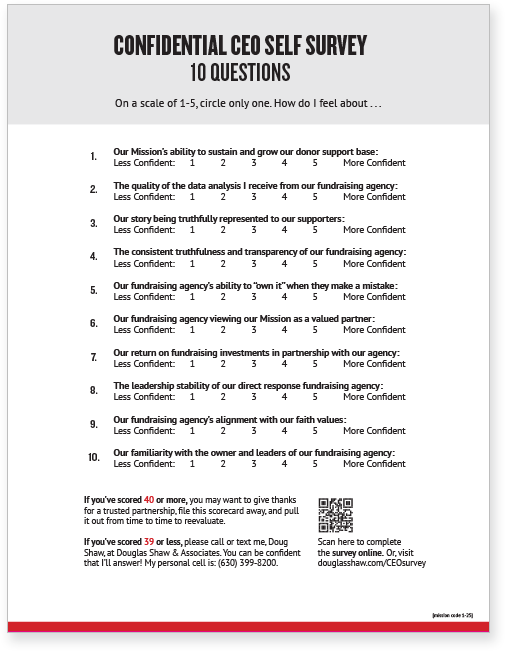
For a starting point, use Douglas Shaw & Associates’ 10-question Confidential CEO Self Survey to reflect on your current partnership, including donor growth, data analysis, transparency, accountability, stability, and shared values.
The right fundraising partner should give you confidence, clarity, creativity, and—above all—honesty. Douglas Shaw & Associates has provided all four to effective nonprofit partners for more than 32 years. Contact us today to start the conversation about your next step in improving your fundraising program—and finding the right partner to do it!
Related articles
-

Rule #64: “Strategy drives EVERYTHING!”
Too often, organizations begin fundraising conversations with tactics. Should we launch a campaign? Send another email? Host an event? While…
-

In 32 Years, Absolutely Nothing’s Changed in Fundraising
Most days, when I sit down with my morning cup of coffee, our little dog Bailey at my side, I…
-

Hiding in Plain Sight
What if meaningful fundraising growth didn’t require a major new campaign, a complete website overhaul, or a dramatic change in…