

Aligning Donor Value from the Very First Gift
Mark Mangin
Senior Vice President of Data and Analytics
Maximizing Dollar Efficiency in Fundraising: Aligning Donor Value from the Very First Gift
Fundraising teams invest extraordinary effort and budget to acquire new donors, yet a surprising amount of potential revenue never materializes. The root cause is usually the same: potential donors are not curated (or later stewarded) at levels that reflect their giving capacity.
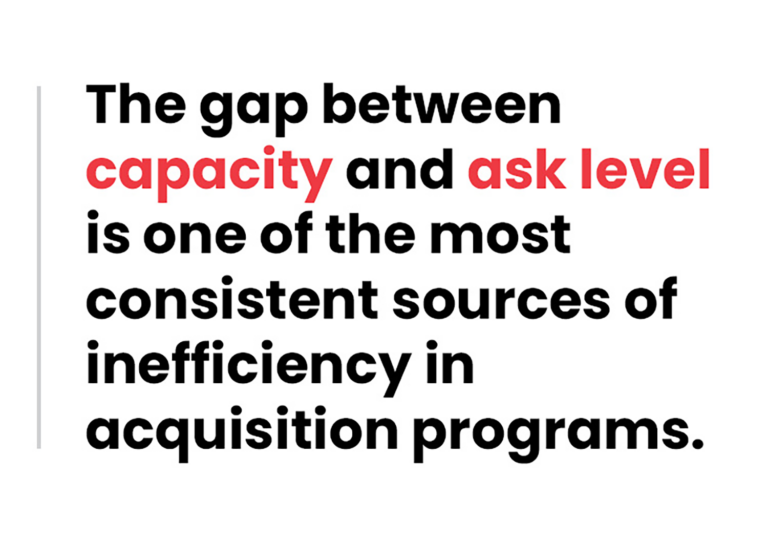
When a potential donor is asked for less than they can comfortably contribute, the organization could miss a significant opportunity. When a potential donor is asked for more than they can reasonably give, they often choose not to respond. This gap between capacity and ask level is one of the most consistent sources of inefficiency in acquisition programs.
It’s not just about the ask amount, though. From our work at Douglas Shaw & Associates, we’ve learned it’s about whether the offer, message, creative, and first gift follow-up match who that donor is, their capacity, their connection to your mission, and the role they want to play in growing your impact.
Misaligned Asks Lead to Lost Revenue
Many acquisition programs are built on averages. Average ask amounts. Average package formats. Average creative treatments. But average campaigns will produce average results, and donors don’t give in averages. They give in ways that feel appropriate to their capacity and their sense of impact.
Two patterns tend to create the greatest loss of potential revenue: Asking too much or asking too little. When high-capacity donors receive low-value solicitations, they often give at the level you’ve asked for. The problem is that this early anchor can suppress their long-term giving. Donors use the amounts you present as a reference point for what’s typical or generous, and future gifts are often similar in size. What looks like an early “win” can limit lifetime value.
If the solicitation feels out of reach—too large, too urgent, or mismatched to the donor’s financial reality—many potential donors may simply choose not to respond at all. They don’t downgrade. They opt out.
In either case, the donor’s first interaction with your organization helps shape the long-term relationship, for better or for worse.
What Data Shows About First Gift Value
An analysis across Douglas Shaw & Associates’ clients shows a consistent pattern: small increases in the initial gift amount correspond to higher five-year value.
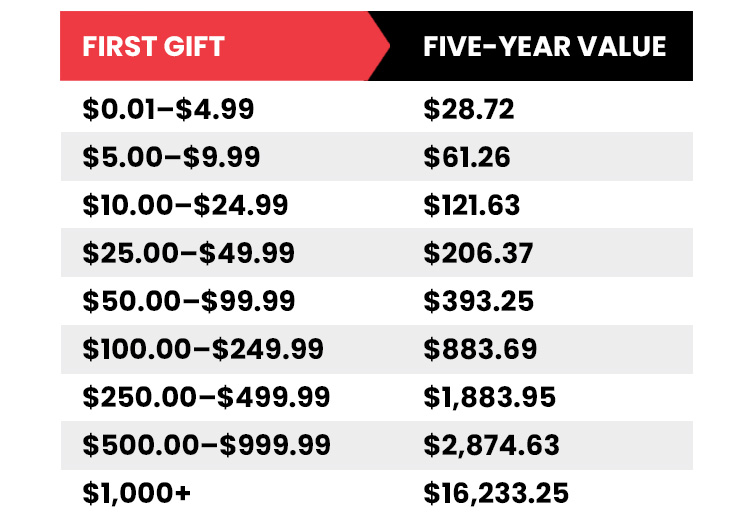
A donor acquired at $25 is worth about $206 over five years. A donor acquired at $100 is worth nearly $884. And a donor acquired at $250 averages almost $1,900. At the highest levels, first gifts above $1,000 yield a five-year value exceeding $16,000.
These are not one-size-fits-all benchmarks. They vary by ministry, channel, and offer. But the pattern is unmistakable. The higher the first gift, the stronger the long-term value. Every incremental increase in first-gift alignment compounds into years of improved performance.
This is why aligning the acquisition experience to a potential donor’s capacity is a critical piece of the equation to long-term donor engagement and growth.
Why the Second Gift Matters, Too
However, the first gift amount isn’t the whole story. Once a donor makes a second contribution, retention rates jump dramatically. This means two things:
- A strong first gift is a signal of capacity. It tells you this donor can likely support your mission at a meaningful level.
- What you do immediately after that first gift helps further determine whether capacity becomes lifetime value. Timely and heartfelt thanks, a clear sense of impact, and an intentional second‑gift strategy are often just as critical as the first ask.
If you optimize for high first gifts but neglect welcome journeys and second‑gift strategy, you may end up with a shrinking donor file that’s vulnerable to shocks.
High-Value Donors Need High-Value Experiences
There is a common misconception that a single package format or a single offer can attract donors across all value bands. But high-capacity donors respond differently than lower-capacity donors. They often look for:
- Messaging that reflects the scale of impact you’re asking them to make
- Creative that feels substantial, mission-forward, and impactful
- Offers that present meaningful, tangible outcomes they can personally influence
- Tone and presentation that signal significance, not casual fundraising
When the opportunity feels too small, too lightweight, or too modestly packaged, high-value donors often don’t see themselves in it. When it feels all about the money and not about the mission, they don’t see themselves in it either. To acquire and retain high-value donors, you must give them a high-value, mission-aligned experience from the first touch through to their second, third, and 10th gift!
Alignment Should Run Through the Entire Campaign
Matching the ask to capacity is important, but it’s just one element of a larger system. True efficiency comes from aligning all campaign components so that prospects receive a coherent, appropriately scaled invitation.
This means the offer and its framing should connect with the look and feel of the creative packaging, which should be consistent with the requested gift amounts specified for that individual. Those need to be aligned with and informed by the models that have been used to identify and select potential donors. Even decisions about how the merge-purge is executed should be viewed through the lens of alignment with donor value.
When these elements work together, the potential donor experiences a coherent story about the scale of the need or opportunity, the level of investment that’s appropriate for them, and the difference their gift can make. When they are out of sync—such as strong lists with weak creative, high-value packaging with a diluted offer, or great modeling paired with low-impact messaging—results can suffer no matter how refined the ask array may be.
Alignment is the system, not the tactic.
Why This Matters Most in Acquisition
Acquisition is the moment when the potential donor decides who they are in a relationship with your organization. The first gift (and what happens immediately after) becomes a reference point for future behavior. It can predict how often the donor gives, how much they give, whether they upgrade their giving, how long they stay an active giver, and whether they are likely to become mid-level or major donors.
When the first gift aligns with capacity and is followed by a thoughtful journey, everything downstream works better. When it doesn’t, the donor’s potential is capped from the beginning.
The Opportunity Ahead
Organizations that commit to full-system alignment consistently see:
- Higher first-gift amounts
- Stronger first-year and multi-year retention
- More predictable long-term value
- Better cost-per-dollar-raised
- More high-value donors entering the pipeline
- Stronger mid-level and major-gift development
This isn’t about squeezing more money out of donors. It’s about honoring the generosity God has already placed in their hearts by inviting them into opportunities that match their capacity and convictions.
Conclusion
Dollar efficiency isn’t achieved by cutting campaigns or relying on averages. It comes from designing acquisition programs that honor donor capacity and present every donor with an opportunity that matches who they are and what they can give.
When creative, offer, targeting, and timing all reinforce the same level of value, you stop leaving opportunities on the table and start building long-term donor relationships that pay dividends for years, both for the organization and the donor.
Let’s keep the conversation going! Feel free to reach out to us with your thoughts, experiences, or questions as we continue this journey together.